In Mathew 2:13-14 we’re told that in order to avoid King Herod’s wrath in Bethlehem, Joseph, Mary, and baby Jesus are to (at the instruction of an angel) flee to Egypt and await Herod’s death.
It’s in the next verse, Mat. 2:15, that we find out that Mathew the tax collector may have had an ideological axe to grind.
Mat. 2:15 “and they stayed there until Herod’s death. This fulfilled what the Lord had spoken through the prophet [Hosea]: “I called my Son out of Egypt.”
Here Mathew is referring to Hosea 11:1 (Chapter 11 is so named “God’s love for Israel”).
Hos. 11:1 “When Israel was a child, I loved him, and I called my son out of Egypt.
God appears to simply be recalling when he guided his nation Israel, through Moses, out of Egypt— and of slavery. It’s not clear how any honest interpretation of the book of Hosea reveals a messianic prediction.
Hosea likely recorded his prophecies while living and professing in the Northern Kingdom of Israel (755- 715 BCE), during the reign of Jeroboam II. During this period, Israel found financial as well as military success through expansion and Israel-Assyrian trade agreements.
With the worship of idols and an increase in foreign influence, it’s no surprise that Israels spiritual strength was considered to be at an all time low— which is precisely what Hosea was prophesying about (or what God was speaking about through Hosea). His people were supposedly worshipping Asherah poles, golden calfs (As the ones built in Dan and Bethel) and only making sacrifices so that they may feast.
In the book of Hosea, God anthropomorphically states his displeasure with his people (specifically the Northern kingdom of Israel, or Ephraim). Several time’s God uses analogies to describe his relationship to Israel.
Israel as it’s mother and as God’s wife:
Hos. 2:2 “But now bring charges against Israel—your mother— for she is no longer my wife, and I am no longer her husband.”
And,
Hos. 2:19 “I will make you my wife forever,”
Also,
Hos. 4:5 “So you will stumble in broad daylight, and your false prophets will fall with you in the night. And I will destroy Israel, your mother.”
Israel as a baby:
Hos. 11:3 “I myself taught Israel how to walk, leading him along by the hand.”
Furthermore, God continues to describe the conditions for Israels downfall and several time refers to when he rescued them out of Egypt. Nowhere is there a singular mention of Jesus or a future messiah and half-baked prophesies like this one damage the authenticity and reliability of the gospels as a source of divine inspiration.
“The person who is certain, and who claims divine warrant for his certainty, belongs now to the infancy of our species.”
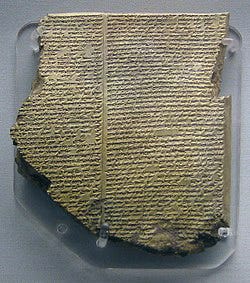
The Epic of Gilgamesh is a four thousand year old poem, first discovered in Ashurbanipal’s Library in modern-day Iraq. It continues to stay relevant and provide us with a fascination tale which seeks to answer the most important problem facing man— the human condition. It’s a love story, action-adventure, with sprinkles of philosophy and humor throughout its sixty or so pages or twelve tablets if you’re reading it in Cuneiform, it’s original language. It also happens to be the first ever story that mentions zombies— if only briefly; it truly is worth a read. I’m using Penguins Group’s translated by N.K. Sanders.
I’m going to analyze the epic alongside the Hebrew Bible to showcase some interesting parallels— specifically within the Torah and the Bible’s so-called Deuteronomistic history (the books of Joshua, Judges, Samuel, Kings, and Jeremiah)
The Flood tablet
PT 1. The Coming of Enkidu
We’re first introduced to a powerful man called Gilgamesh, King Gilgamesh, of Uruk (Warka, Iraq). It’s said that no woman is safe from Gilgamesh on her wedding night and no man can best him.
The word shepherd is repeated twice, the first half of the first paragraph lists a series of undesirable qualities and then;
“yet the king should be a shepherd to his people.”
And again the first half of the second paragraph lists Gilgamesh’s atrocities and then;
“yet this is the shepherd of the city, wise, comely, and resolute.”
By saying, of the city, rather than, to his people, the authorhighlights where Gilgamesh places his priority and could even double as a description of the city itself— wise, comely, and resolute.
So the gods hear the wailing from Uruk and they themselves complain to Aruru, the goddess of creation:
“You made him [Gilgamesh], O Aruru, now create his equal; let it be as like man as his own reflection, his second self, stormy heart for stormy heart.”
So, Aruru makes for Gilgamesh a rival to drain the king’s energy so he may leave the men of Uruk to their wives. Echoes from Genesis can be heard as the goddess creates Enkidu (from clay) after “conceiving an image in her mind”
“Let us make man in our image, after our likeness.”
Gen. 1:26 IPS
Enkidu
Enkidu is described as a ‘wild-man’. He’s said to have long hair like a woman, his body is rough and muscular, and matted hair covers his whole body like that of Samuqan’s— the god of cattle. Enkidu is innocent and knew nothing of the spoils of civilization, so he was uninterested in them and wasn’t tempted by them. Likewise, Adam and Eve are seemingly innocent and shameless prior to eating the fruit from the Tree of Knowledge of good and bad.
Soon Enkidu is running with the wild beasts, drinking from watering holes, and apparently helping his fellow animals escape holes and traps set for them. The trapper who laid them out is terrified of Enkidu and vexed at him for helping the wild animals get out of his traps. So, he asks his father for advice and is told to travel to Uruk and speak with King Gilgamesh. His father instructs him to ask Gilgamesh for a harlot from the temple of love, and to present the prostitute to Enkidu. Gilgamesh tells her that once the wild beasts witness Enkidu making love as a common man, they’ll reject him.
And that’s exactly what happened.
For six days and seven nights the harlot showed Enkidu a woman’s body and they made love. When he was through with the woman he travelled back home only to find that the wild beasts, once his familial companions, now “bolted away” from Enkidu— his body was taught like a rope when he tried to chase after them. Enkidu grew weak, “for wisdom was in him”. Similarly, Adam and Eve underwent a quasi apotheosis transformation when they ate the fruit from the tree of knowledge of good and bad. Furthermore, it’s worth acknowledging that the females in both myths seem to initiate the metaphoric fall from a sort of natural existence and peace.
The harlot then tells Enkidu that the animals will always run from him and that somehow he’s forever changed.
“You are wise, Enkidu, and now you have become like a god.”
In the Hebrew Bible, Adam and Eve were banished from the Garden of Eden after eating from the Tree of Knowledge of good and bad, but why? Why wasn’t increased childbirth pains and toiling the soil for food enough of a punishment? Why the total banishment along with an ever turning flaming sword and a cherubim to guard the way back into the garden? Because the author is attempting to convey to us that God knew that with wisdom, humans have become ‘like god’s’ and that they could even rival God [Yahweh].
The harlot tells Enkidu about the king of strong-walled Uruk— in an apparent effort to recruit his aid. She tells him of Gilgamesh’s strength and it excites him, Enkidu looks forward to a ‘comrade’, someone to wrestle with and know like a brother. In a clever, poetic transition, the harlot tell him that Gilgamesh is so powerful and god-like (2/3 divine, and 1/3 mortal to be precise) that he will dream Enkidu’s arrival in Uruk— which Gilgamesh promptly does.
In an obscure section, Gilgamesh describes two dreams he had to his mother, Ninsun (a minor goddess), who then tells her son that the dreams represent Enkidu’s arrival, or someone like him. While this is happening in Uruk, the harlot teaches Enkidu the arts of civilization— he learns to eat bread and drink wine from a goblet as mortal men do— notice the emergence of the bread and wine theme that’s popular among ancient Near Eastern myths, perhaps making its first appearance here in this poem.
Enkidu is said to have emptied a total of 7 goblets— 7 is a favorite number in The Hebrew Bible (along with 3, 10, 12, 40, and any “desirable numbers” such as multiples of 7 or whole numbers). Mathew’s gospel actually traces Jesus’s genealogy to Adam in an interesting coincidence of numbers. David, or DWD with numeric values added to each letter will add to 14. It matters because 14 is the amount of generations Mathew places between Jesus and David, David and Abraham, and Abraham and Adam— 14 is also a multiple of 7 on top of it all. This only matters if we’re discussing the New Testament but it’s too interesting to not mention briefly.
Now Enkidu arrives in Uruk to challenge Gilgamesh. The people crowed around him and whispered their curiosities (exactly as they had in Gilgamesh’s dreams). That night, as Gilgamesh was on his way to the bridal bed (to take another virgin from her husband), a stranger stood in his path.
Queue epic fight music
Well not really, much like you’d expect two Sumo wrestlers to embrace, so did Enkidu and Gilgamesh. Locked in a desperate struggle for ground, the two stood pressing the other— like rams fighting over territory, where every inch matters. Until finally, Gilgamesh tosses Enkidu and in a turn of events the two embrace and, “their friendship was sealed”.
“Gilgamesh, you son of a bitch”
PT 2. The Forest Journey
Again Gilgamesh dreams but it’s Enkidu, not Ninsun, who interprets them. He explains to the king that while the kingship is his [Gilgamesh’s] destiny, everlasting life is not. Enkidu goes on to express his own frustration with his recent assimilation into civilized life. He feels weak and slow.
“I am oppressed by idleness”
— Enkidu
Suddenly, we’re told that Lord Gilgamesh;
“turned his thoughts to the Land of the Living”
Right away we notice the use of the title lord given before the kings name where it had not been previously. Next, assuming the “Land of the Living” is referring to Earth, when did Gilgamesh become a god? We know he has divine heritage but never that he has the ability to traverse some primordial dimension. Or was the original author(s) simply stating that since Gilgamesh was previously thinking of the mortal life the god’s cursed upon him, was he returning his mind to the present moment?
Gilgamesh suggests to Enkidu that they should travel to the Cedar Forest (assumed to be modern day Iran) and kill the giant Humbaba, but Enkidu gives his new friend a bitter warning.
“When he[Humbaba] roars it is like the torrent of the storm, his breath is like fire, and his jaws are death itself.”
King Gilgamesh ignores his friends warning and boasts of his own power and strength before sacrificing two goats to Shamash, the sun god. To which Shamash accepts and the fellas have some weapons made for their journey. Meanwhile Ninsun goes to the palace roof and to ask’s for Shamash’s blessing and ask’s him to watch over Gilgamesh. Then she adopts Enkidu and charges him with servitude to Gilgamesh.
“Serve Gilgamesh as a foundling serves the temple and the priestess who reared him.”
Almost out of the city and on their way to victory, Gilgamesh and Enkidu are met by the councillors of Uruk (likely the other Gods we’ve already met). They tell Enkidu that he must protect Gilgamesh and see to his return, they also tell him that he alone must lead the way.
“The one who goes in front protects his companion; the good guide who knows the way guards his friend.”
Our hero’s make it through seven (there’s that number again) mountains and to the gate of the Cedar Forrest and now we’ll take another look at the more recent piece of Near Eastern literature, the Hebrew Bible.
“So Hiram kept Solomon provided with all the cedar and cypress wood he required,” 1 Kings 5:24 IPS
Here, King Solomon (well known collector of all things ancient and foreign), strikes up a newfound friendship with King Hiram of Tyre (Lebanon), and receives lumber, specifically cedar, among other building supplies for the construction of the first Temple in Jerusalem.
Why does it matter?
Well, it’s not uncommon for ancient Mesopotamian neighbors to form alliances for the acquisition of natural resources (cedar). Furthermore, those allies (Gilgamesh and Enkidu) would be forced to go to war with the inhabitants of said recourses (Humbaba). The similarity between the spelling of Hiram and Humbaba is also relevant. Considering the dozens of other glaring similarities between this epic and stories from the Hebrew Bible, it isn’t far fetched to imagine the Deuteronomistic history, having key roots in The Epic of Gilgamesh— among other local myths.
Moving on, Gilgy and Enky take a break under the shade of the cedar. It may seem insignificant but the hero(s) of a story taking rest in the shade of a tree(s) is a common trend in near eastern folklore. Not to mention the scene of a single or small cluster of trees providing shade for the weary wanderer is certainly a motif of it’s time and region— being set in ancient Mesopotamia.
“Its shade was beautiful, full of comfort; mountain and glade were green with brushwood.”
Can be easily reconcilable when read side by side with something like:
“he himself went a day’s journey into the wilderness. He came to a broom bush and sat down under it,” 1 Kings 19:4 IPS
Going deeper into the forest, Gilgamesh and Enkidu lay down to sleep and Gilgamesh needs yet another couple of dreams interpreted. In one nightmare, Gilgamesh fought a wild boar, which will be of great significance later on. Enkidu will tell him that his dreams mean they will have favor in their upcoming battle against Humbaba.
Now it’s Enkidu who does a bit of dreaming, except we’re not told exactly what it was he dreamed about, we’re only told how he responded to it;
“it caused him to cower like the mountain barley under a storm of rain.”
In Genesis 37:7, Joseph gloat’s to his brothers about a dream he had, in which they were all “binding sheaves”— which are bundles of grain such as wheat and barley.
Finally after a little more dreaming, Gilgamesh tears down a cedar tree— beckoning the attention of it’s guardian, Humbaba.
When Gilgamesh and Enkidu were poised to strike, Shamash calls down to them:
“Go forward, do not be afraid.”
We see close translations to divine command such as this one, again in the deuteronomistic history; specifically in Deuteronomy 21:6, 21:8, and again in Joshua 1:9.
Gilgamesh slaps on his breastplate ‘A Voice of Heroes’ and Enkidu issues him another warning of Humbaba’s might, but Gilgamesh reassures his brother that:
“Immolation and sacrifice are not yet for me, the boat of the dead shall not go down, nor the three-ply cloth be cut for my shrouding.”
Examples of grief stricken individuals tearing their clothes from their body to signify grief are commonplace in the deuteronomist’s history.
“Jacob rent [tore] his clothes, put sackcloth on his loins, and observed mourning for his son many days.” Genesis 37:34
Seven times, Gilgamesh and Enkidu cut down Humbaba’s cedar trees and seven times, does Humbaba ‘loose his glory’ on the two men. But before long, Humbaba is pleading for his life, saying:
“Let me go free, Gilgamesh, and I will be your servant you shall be my lord; all the trees of the forest that I tended on the mountain shall be yours.”
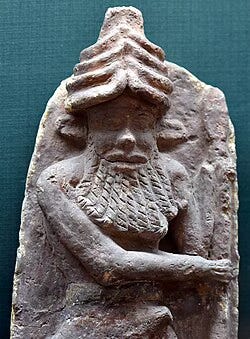
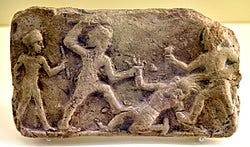
Humbaba’s death
One could note the similarity between this peace offering of lumber and servitude with similar Hittite contracts wherein the Hittite’s list the conditions of the concurred peoples surrender— to include what resources are to be allocated to the victorious Hittites.
Despite Humbaba’s offering and at the behest of his companions advice, Gilgamesh attacks the watcher of the forest.
“and he [Gilgamesh] struck Humbaba with a thrust of the sword to the neck, and Enkidu his comrade struck the second blow. At the third blow Humbaba fell.”
Once the seven splendors of Humbaba were extinguished, and enraged Enlil scattered them, Gilgamesh and Enkidu ‘felled’ several more sacred tree’s before leaving the Cedar Forest.
PT 3. The Rejection of Ishtar & Death of Enkidu
With the great Humbaba slain, Gilgamesh and Enkidu return to Uruk. Once home, Gilgamesh changes out of his rags, cleans himself, and dresses in a robe. Ishtar, goddess of love, fertility, war, patroness of Uruk and daughter to Anu, sets her eyes on Gilgamesh and offers to take him as a bridegroom. To which Gilgamesh spurns her advances, stating:
Your lovers have found you like a brazier which shoulders in the cold, a backdoor which keeps out neither squall of wind nor storm, a castle which crushes the garrison, pitch that blackens the bearer, a water-skin that chafes the carrier, a stone which falls from the parapet, a battering-ram turned back from the enemy, a sandal that trips the wearer.”
So, not too flattering. Gilgamesh doesn’t stop there though, he then verbally walks Ishtar through a list of her exes and how better of they each would have been without her. These past lovers include: Tammuz, the many-colored roller, the lion, the stallion, the shepard, and Ishullanu. Insulted and feeling angry, Ishtar storms to her parents in Heaven and beckons her father for ‘The Bull of Heaven’— that she might set it loose on Gilgamesh for his transgressions against her.
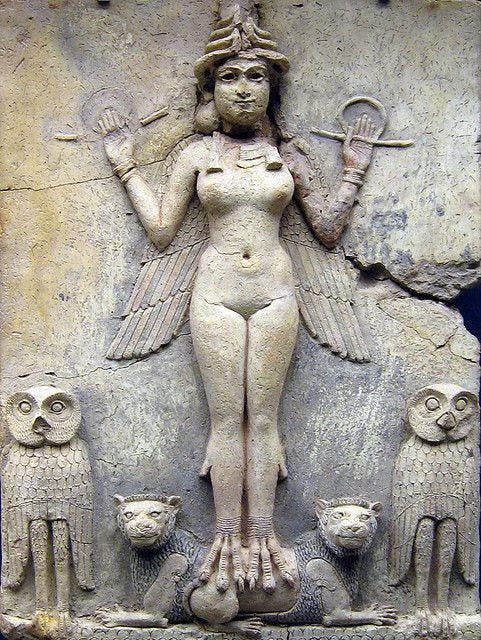
Ishtar
Papa Anu (father of gods) gives in to his daughter and sends the Bull of Heaven to Uruk— but not before explaining that with this bull, comes famine to Uruk. The idea of a bull or calf being accompanied with a famine isn’t an unfamiliar myth for this time or region.
“when out of the Nile there came up seven cows, handsome and sturdy, and they grazed in the reed grass.” Genesis 41:2 IPS
In this story in Genesis, Pharaoh is having troublesome dreams so he calls for Joseph, who interprets his dreams as representing an inevitable famine about to fall over Egypt. Here are three common motif’s; dream interpretation, calfs or cattle of a sort, and famine— what a time to be alive.
So the bull comes down and in another episodic scene, it’s killed by our heroes. Not before, however, it cracks the earth open 3 separate times. Each time hurling groups of men to their deaths. This is yet another potential kernel of parallels attached to the Hebrew Bible.
“Scarcely had he finished speaking all these words when the ground under them burst asunder, and the earth opened its mouth and swallowed them up with their households, all Korah’s people and all their possessions.” Numbers 16: 31-33
Here, the people of Torah are punished for rebelling against Moses and Aaron.
After their battle with the Bull of Heaven, Ishtar say’s to Gilgamesh, “Woe to Gilgamesh, for he has scorned me in killing the Bull of Heaven.” Hearing these blasphemous words directed at his brother, Enkidu throws a chunk of the Bull’s leg at her— which is my personal favorite scene in the epic.
Again Gilgamesh dreams and this time, it involves Enkidu’s fate. He dreams, in poetic fashion wherein his dream segues into the scene itself, that the god’s: Anu, Enlil, Ea, and Shamash are discussing what to do with Gilgamesh and Enkidu now that Humbaba, the guardian of the Cedar’s and the Bull in Heaven have been killed. They agree that it’s Enkidu who must ultimately pay.
“So enkidu lay stretched out before Gilgamesh; his tears ran down in streams and he said to Gilgamesh, ‘O my brother, so dear as you are to me, brother, yet they will take me from you’. Again he said, ‘I must sit down on the threshold of the dead and never again will I see my dear brother with my eyes.’
Then, Enkidu cursed the gate to Uruk, the Trapper who reported him, and finally he cursed the harlot, who stole him from the forest, and from his family. This particular curse is a bit too long to include here but it’s a beautiful poem full of morbid imagery and vindictive words.
Finally Shamash, who’s been listening, comforts Enkidu with a reminder that Gilgamesh will mourn his death and grow his hair long while doing so. Again, a mourning practice from the Hebrew Bible appearing in this epic. Enkidu revokes his curse against the harlot and instead blesses her, in a poem that has The Song of Songs undertones within it.
“Woman, I promise you another destiny. The mouth which cursed you shall bless you! Kings, princes and nobles shall adore you. On your account a man though twelve miles off will clap his hand to his thigh and his hair will twitch. For you he will undo his belt and open his treasure and you shall have your desire; lapis lazuli, gold and carnelian from the heap in his treasury. A ring for your hand and a robe shall be yours. The priest will lead you into the presence of the gods. On your account a wife, a mother of seven, was forsaken.’”
Enkidu dreams of a sombre-faced man-bird, Irkalla the Queen of Darkness, a house of dust, and of other mystical relics. Gilgamesh watches over him as he suffers for twelvedays. On the twelfth day he shares his regret of not dying a heroes death in battle, and dies.
For seven days and seven nights Gilgamesh mourns for Enkidu, he makes all of Uruk mourn with him. Then, he wanders the wilderness— much like the Israelites in the book of Exodus. In his final act of respect, he erects a statue of Enkidu, made of lapis lazuli and gold.
End of Parts 1-3
References: Sandars, N.K. (1960) The Epic of Gilgamesh. Penguin Group; (1985) Tanakh The Holy Scriptures. Jewish Publication Society



 Staying Secular